Why industrial maintenance technicians are difficult to recruit
Manufacturers depend on maintenance professionals to keep equipment safe, reliable, and productive. When a technician position remains open, preventive work may fall behind, response time can increase, and experienced team members often absorb additional overtime or emergency coverage.
The candidate pool is limited because the strongest technicians combine mechanical ability with electrical, controls, automation, and troubleshooting experience. Many are already employed and receive frequent recruiting outreach. A successful search requires more detail than a general advertisement for a maintenance mechanic.
Start with the actual equipment and work
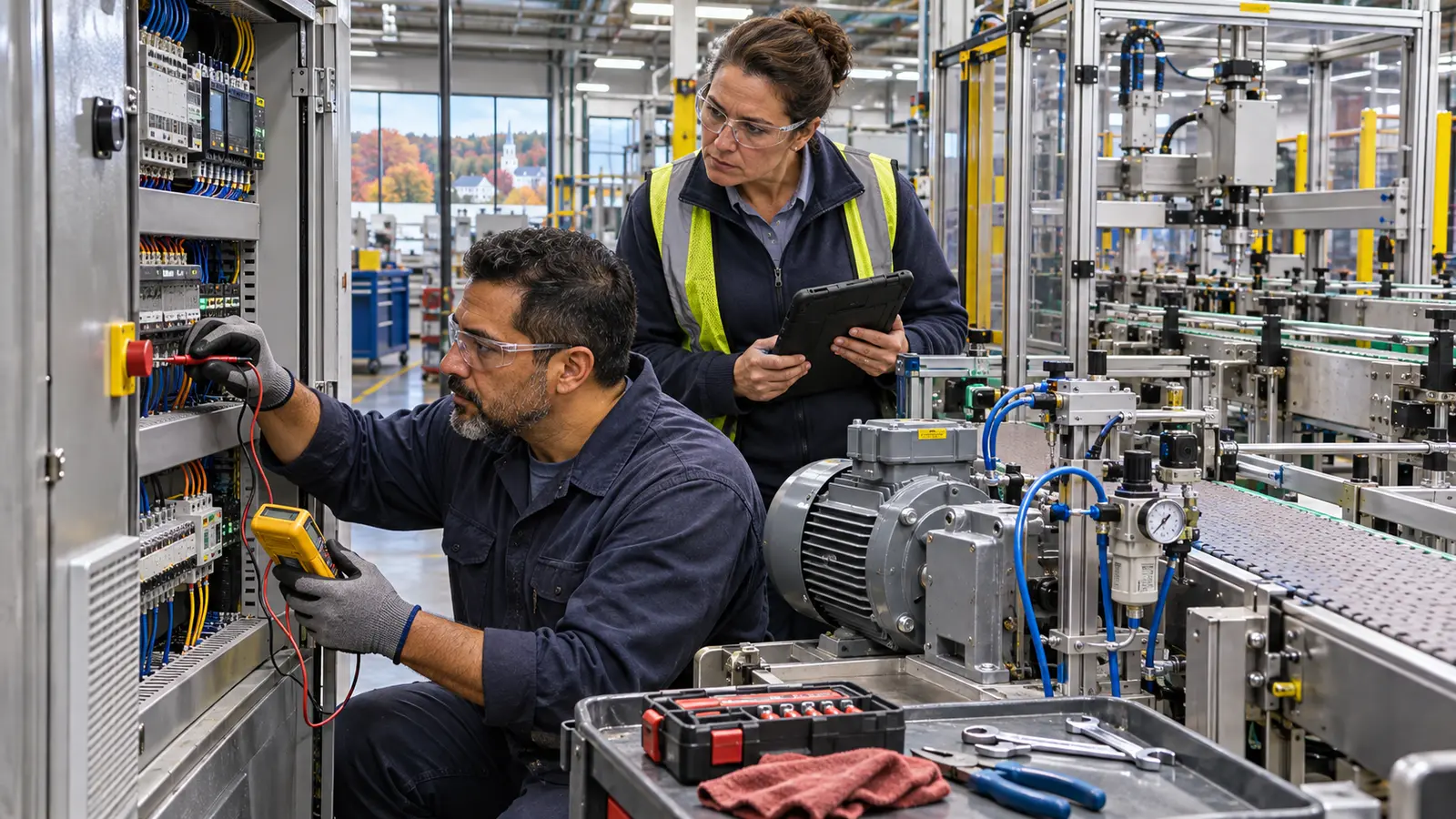
Maintenance titles vary widely between employers. One technician may focus on motors, bearings, conveyors, and mechanical repairs. Another may troubleshoot PLC inputs and outputs, variable-frequency drives, robotics, sensors, servo systems, and automated production cells.
Create a requirement based on the equipment, failure modes, and daily responsibilities in your facility. This gives recruiters a useful screening framework and helps candidates understand whether their experience transfers.
- Production equipment, machine brands, and control platforms
- Electrical voltage and troubleshooting expectations
- PLC, HMI, robotics, drives, and automation responsibility
- Motors, gearboxes, conveyors, pumps, and mechanical systems
- Hydraulic, pneumatic, steam, refrigeration, or facility systems
- Preventive and predictive maintenance responsibilities
- Documentation, CMMS, spare parts, and work-order expectations
Separate essential skills from trainable experience
Employers sometimes combine every possible maintenance skill into one requirement. That can eliminate capable candidates who meet the most important needs and can learn the remaining equipment. Identify the skills required on the first day, then separate them from experience that the maintenance team or equipment supplier can teach.
A candidate from food production, packaging, plastics, aerospace, medical devices, or another industry may have relevant experience with similar motors, conveyors, sensors, controls, pneumatics, and preventive-maintenance systems. Evaluate the underlying work instead of relying only on industry labels.
Evaluate troubleshooting rather than keywords
A résumé may list PLCs, hydraulics, electrical systems, or preventive maintenance without showing the candidate's level of independence. Structured questions should uncover how the person approaches an unfamiliar failure, isolates a cause, uses drawings and test equipment, communicates production risk, and confirms the repair.
Ask for a detailed example of a difficult breakdown. Strong answers describe symptoms, safety steps, diagnostic sequence, tools, evidence, repair, restart, and follow-up. The candidate should distinguish personal work from the contribution of electricians, engineers, vendors, or other technicians.
- How did you make the equipment safe before troubleshooting?
- Which information and test equipment did you use?
- How did you separate electrical, mechanical, and controls causes?
- What did you repair or replace personally?
- How did you confirm reliable operation after restart?
- What follow-up prevented the failure from recurring?
Screen electrical and controls experience precisely
Terms such as electrical experience and PLC knowledge can mean very different things. Clarify whether the role requires reading schematics, working with three-phase power, troubleshooting sensors, replacing drives, tracing inputs and outputs, making program changes, or writing controls logic.
Employers should define voltage limits, licensing requirements, arc-flash expectations, lockout procedures, and when work must be escalated. Accurate screening protects safety and prevents both sides from discovering a major skill mismatch during the interview or after hire.
Make the shift and on-call expectations clear
Maintenance hiring often becomes difficult when the position involves second shift, third shift, weekends, rotating schedules, or emergency call coverage. Candidates need the complete schedule, overtime expectations, staffing level, and training plan before investing in the interview process.
Employers competing for off-shift technicians should consider shift differentials, predictable scheduling, overtime clarity, paid call coverage, and a defined path to preferred shifts when possible. Hiding an unpopular schedule until late in the process creates withdrawals and weakens trust.
Present a credible maintenance environment
Candidates evaluate the condition of the equipment, the size and experience of the team, access to tools and parts, leadership support, safety culture, backlog, and the balance between planned and reactive work. A technician may decline a higher salary if the facility appears unsafe, unsupported, or permanently trapped in emergency repairs.
Be ready to explain the maintenance strategy, current priorities, training resources, capital plans, CMMS use, and how production leaders work with maintenance. Honest context helps candidates decide whether the opportunity fits and gives the employer a stronger basis for long-term retention.
Use a practical interview and assessment process
A structured interview should test the work that matters without creating an unnecessarily long process. Use equipment-based questions, troubleshooting scenarios, schematic review, or a safe hands-on assessment that reflects the position.
Define scoring criteria before interviews begin. The team should evaluate safety judgment, diagnostic thinking, technical range, communication, reliability, learning ability, and shift alignment. Avoid trivia that does not predict performance in the facility.
- Safety and lockout judgment
- Electrical and mechanical troubleshooting depth
- Controls and automation experience
- Preventive-maintenance discipline
- Use of drawings, meters, tools, and CMMS systems
- Communication with production and technical teams
- Schedule, compensation, commute, and long-term motivation
Move quickly with qualified technicians
Experienced maintenance candidates often have several options. Long delays between application, interview, plant tour, and offer give competing employers time to move first. Align the interview team and compensation range before recruiting begins.
A focused process can include an initial technical screen, one plant interview with the right decision makers, prompt feedback, references where appropriate, and a written offer that clearly explains base pay, differential, overtime, benefits, schedule, and start date.
Choose the right staffing model
Contract-to-hire can help employers address urgent coverage while both sides evaluate the working relationship. Direct placement may fit experienced technicians who prefer permanent employment and are less likely to consider a temporary assignment. Contract staffing can support shutdowns, projects, backlogs, leave coverage, and seasonal production needs.
The model should reflect urgency, schedule, market conditions, internal onboarding capacity, and the level of specialization. Recruiters should explain the opportunity accurately so candidates understand the employment relationship from the beginning.
- Use contract staffing for immediate or project-based support
- Use contract-to-hire when a working evaluation fits the workforce plan
- Use direct placement for permanent experienced technicians
- Use payroll transfer when the employer has identified the worker but needs employment administration
Industrial maintenance recruiting in Connecticut and New England
BestLogic Staffing recruits industrial maintenance technicians, electromechanical technicians, maintenance mechanics, controls technicians, electricians, automation technicians, facilities professionals, supervisors, and managers across Connecticut, New England, and nationwide.
Employers can request contract staffing, contract-to-hire, direct placement, payroll transfer, and customized recruiting support. Call (866) 585-8055, extension 1, or submit your opening online to begin a role-specific search.
Frequently asked questions
Which industrial maintenance positions does BestLogic Staffing recruit?
BestLogic recruits industrial maintenance technicians, maintenance mechanics, electromechanical technicians, controls technicians, automation technicians, electricians, millwrights, facilities technicians, maintenance planners, supervisors, and managers.
Can BestLogic screen maintenance candidates for specific equipment?
Yes. Screening can cover electrical voltage, PLC platforms, robotics, motors, drives, conveyors, hydraulics, pneumatics, mechanical systems, preventive maintenance, troubleshooting, and employer-specific equipment.
Does BestLogic recruit maintenance technicians for off shifts?
Yes. Searches can target second shift, third shift, weekend schedules, rotating shifts, and other employer-defined coverage needs.
Which hiring models are available for maintenance roles?
Employers can use contract staffing, contract-to-hire, direct placement, payroll transfer, or a customized recruiting plan based on urgency and workforce needs.
Does BestLogic recruit outside Connecticut?
Yes. BestLogic is based in Connecticut and recruits industrial maintenance, manufacturing, engineering, and skilled-trades talent across New England and nationwide.